


 G






What the destroy any website game is
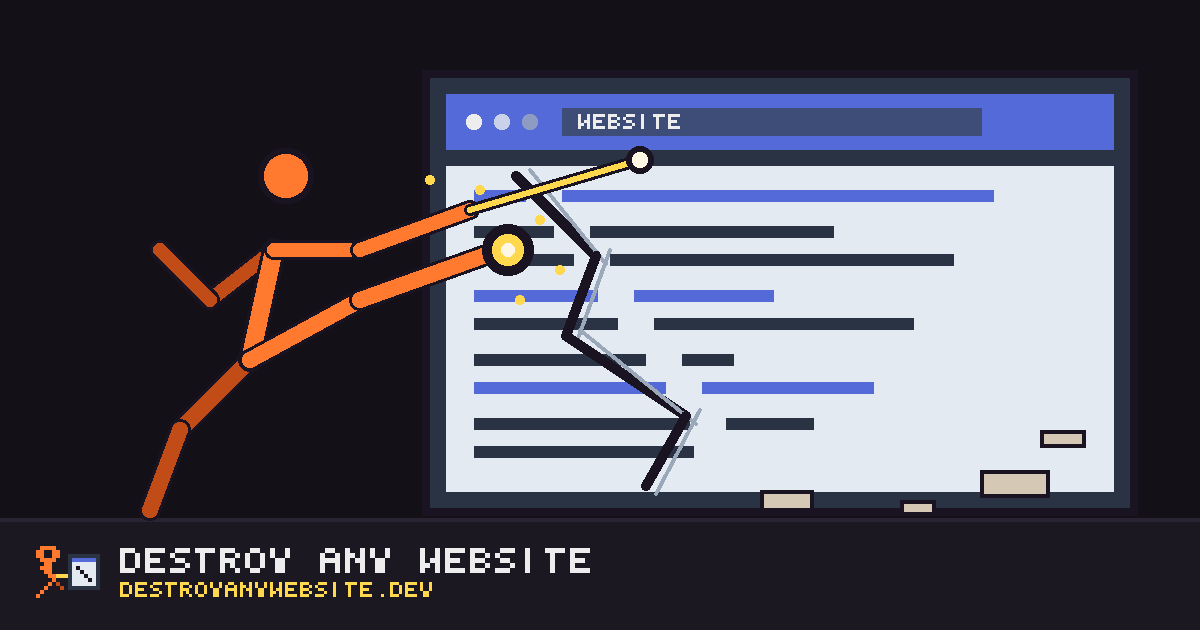
Destroy Any Website is a free stickman game that runs in the browser. The address field at the top of this page is the level select. Type a host, press Destroy, and the layout of that page — headings, pictures, buttons, and boxes — becomes something you can walk on and shoot apart. The stickman, the holes, and the fire exist only in that session. The site you named is left as you found it.
Advertisement
People ask for this in a few different sentences. One person wants to destroy any site that has been sitting in a tab all week. Another says destroy this website, meaning the page already on the screen. Someone else types destroy any web, looking for the same idea with fewer words. Search also turns up destroy website game, break website game, and stickman destroy website. Those phrases land here: one stickman, one URL, and a local copy of the page that can take damage.
How a destroy any website round starts
Leave the field blank, or press Demo page, and the target is archive.org, the Internet Archive homepage. That front page is saved with this site — logo, search box, pictures, and all — so the round starts from the saved copy and does not call archive.org. A short loading bar plays, then the level starts. A Wikipedia address still loads if you type it. So does any other URL you are allowed to request. Custom URLs still go through this origin's proxy, turn the boxes into a grid, and drop the stickman near the top. If a page is so script-heavy that a live copy will not become a level, you get a still snapshot instead of a blank screen.
Desktop controls
On a keyboard, A and D run, and the arrow keys do the same. W, Up, or Space jumps. Hold jump and a jetpack carries you until it needs a moment to recover. S or Down falls through a thin platform. Aim with the mouse. Left click fires the current weapon. Right click or G throws a grenade, which is not one of the numbered slots. The scroll wheel, or Q and E, cycles weapons. Keys 1 through 8 select the standard guns in order. Key 0 selects the exclusive weapon for the character you have selected.
Phone controls
On a phone, the left side of the screen is a stick. Tilt it to run, push up to jump, push down to drop. Press the right side to aim and shoot. A button labeled Grenade sits at the lower right, pause is in the top corner, and the weapon slots line the bottom. A match you started sideways will ask you to turn the phone back if you rotate it upright. A match you started upright can stay that way. The longer control list, plus a few habits that keep you out of your own blast, is on the how to play page.
Challenge mode, where you destroy websites online
The title screen has three modes, and Journey is selected until you choose another. Sandbox is demolition with the guards asleep: nothing on the page comes after you. Challenge is the single page where the page fights back. A few seconds into the round, some buttons and pictures wake up. They hop, crawl, or fly toward the stickman. A touch knocks you back and tumbles you for a moment. In Challenge that does not end the run. Break a block early and that wake-up happens sooner. You can flip between Journey, Challenge, and Sandbox on the title screen, and again from the pause menu during a solo game.
The logo mini-boss
One block is special. The game prefers a logo in the header. When that block finally breaks, it can pull itself back together as a mini-boss: eyes, a heavy landing, and 300 hit points. It is slower than the small minions and much harder to delete with a pistol. Breaking that block drops four coins. Beating the boss drops six more and a gem worth eight. The small fighters are a nuisance. The logo is the thing you plan a rocket for.
Coins and characters
Coins are already hidden when the level starts, in Sandbox and in Challenge. A seeded handful of blocks — about fourteen to eighteen, depending on the address — sit in the part of the page that counts toward destruction, three coins each. Other pieces you break can drop a coin too. The same URL hides them in the same places. A different URL hides them somewhere else. Break one and coins fall out. Coins within reach drift to you, last about forty seconds, and blink before they vanish. One block also hides a gem worth six, and for a couple of seconds coins farther away drift toward you. Destroying the page pays a bonus at 25, 50, 75, and 100 percent, once each on that page. A normal page pays about 100 coins. About 60 percent destroyed pays about 80, and a full clear pays about 160. Multiplayer does not drop or spend them. The total is saved in this browser. It shows beside the character row, and on the HUD once you are playing, including on a phone. You do not sign in, and the coins are not real money.
Those coins unlock five characters past the free stickman. Each costs 400 coins. Magnus fights with a magnet: hold fire to pick up a chunk of the page, release to throw it, and the coin pull reaches farther while the magnet is out. Digger fights with a drill charge: press fire and a spinning bit bores through the page, then detonates. Clown fights with Punchline, a spring-loaded glove that punches the page so loose chunks smash what they hit. Hex calls down a Meteor that craters, then rolls a trench. Nova throws a Tesla Coil that sticks and arcs lightning through nearby pieces. Each paid hero is about four pages of normal play. The stickman stays free and keeps the standard guns — Meteor and Tesla Coil are not on that free belt. A character card only previews. Select applies it. If the character is locked, the button reads Unlock and the coin price, and it stays disabled until you can pay. X and Esc close the dialog and leave the current character alone. What each gun is for sits on the arsenal page. The wake-up rules are written out on the challenge page.
Journey, one page after another
Journey uses the same fight as Challenge: minions, the logo mini-boss, coins, and the destruction bonus. The run does not stop on one page. Once most of the page is destroyed, a portal opens on a real link at the end of the page, with the domain written above it. If the last pieces will not break, it still opens after a short wait. An arrow points to it when it is off the screen. Walk into it and the next site loads as the next level. Monsters do not have to be down first. If every monster that showed up is already down, stepping through pays a Full Clear bonus. Health and coins come with you. Each later level fields a few more minions, and they are a little faster and a little harder to break. The destruction bonus starts over on every page. A minion's touch costs health, and a boss slam costs more. Small hearts sometimes drop and put a little health back. Running out of health, or falling off the page, ends the run. The score screen lists the level you reached, the pages you walked, the coins you earned, and how much of each page you destroyed. Retry starts that run again. Share copies a line and a link. Leave the address blank and the first page is still the saved archive.org demo. Later pages load through the proxy. If a portal's site will not load, the words Portal collapsed appear and another portal opens.
Other players in the same copy
Play online opens the multiplayer menu. Create a room and the link is this site plus a short code. Up to six people can join. The host chooses the page. First to 10 kills wins. Quick match skips the waiting room and drops you into a 90-second round on a built-in arena. The player with the most kills at the buzzer takes it. Quick match also locks four weapons that would end a short round too fast: the railgun, Too Much, Tesla Coil, and Meteor. Destruction is shared either way. A hole you open is a hole the rest of the room can fall through.
Coins, minions, and the logo boss do not run while other people are in the match. The fight-back layer is off so a room stays a match against players. Your coin balance on this browser is not spent or earned by the round. If you want the page to chase you, play solo in Challenge or Journey.
The page a website destroyer game actually breaks
The thing on the canvas is a copy. This site fetches the URL, rewrites images and styles so they load from here, and hands the geometry to the game. Burned letters, missing pictures, and a trench through a headline are not written back. Open the real site in another tab and it is the same page it was. That is also why proxy paths, room sockets, and the injected script are kept out of the public site map. They are plumbing, not pages.
Built-in arenas
Built-in arenas exist for when you do not want a website at all. Quick match picks among them: a desktop, a dock, a moon base, candy, a rooftop, and others. They are original levels with the same job as a web page, which is to give a stickman somewhere tall to fall. They do not stand in for the address field. If you came to break a particular site, type that host.
A few practical notes before you scroll back up. Explosions shove you. Rockets, grenades, Too Much, the drone's blast, and a Meteor impact all knock the stickman, so fire them while you are already moving away. Sandbox is the calm way to learn an unfamiliar layout, and it hides the same coins. Challenge is where the page wakes up and the logo boss pays extra. Journey keeps that fight and walks you into the next site once most of the page is gone. The FAQ covers whether this is safe, whether the real site changes (it does not), what stays on your device, phones, and multiplayer. About is the short note on this project.
This article sits under the game so the viewport you play in stays a full screen. The field at the top is still there. Scroll up, type an address, and press Destroy.